
Murray County Projected vs Actual Release
A projected date is a current calculation or planning point. An actual release date records when custody ended. They may match, but a projected Murray County release can move when a sentence is corrected, a court enters a new order, credits change, parole review changes, or another agency has a hold. County jail and state-prison dates also come from different sources.
A person awaiting trial at Murray County Jail usually does not have a sentence-based projected release date. Release may occur through bail, citation, own recognizance, dismissal, or another court action. The official jail FAQ supports those local routes, but it does not publish a local calculator. A person serving a GDC sentence may have release information in the state offender record.
Leaving Murray County Jail does not always mean community release. A transfer to GDC, another jail, federal custody, or ICE ends county custody but starts or continues custody elsewhere.
The label beside a date is crucial. A maximum release date reflects a state sentence calculation. A TPM reflects a parole-review month. A county release time reflects the jail's processing of an order or other lawful release basis. An old court sentence may explain the total term, but it may not show later credit decisions, revocation orders, or the current location. Compare the label, source, and update date before making plans.
Find a Murray County Projected Date
The best source follows the sentence. Georgia.gov directs county jail questions to the county and state-prison questions to GDC. Start with enough identifiers to avoid mixing records, then verify the result with the office that owns the underlying order or computation.
- Identify the last custody system. Call Murray County Jail if the person was arrested locally and ask whether the person is held, released, or transferred.
- For county custody, ask whether there is a bond, citation, recognizance release, sentence, hold, or court order affecting release. Request the booking or release record if a phone answer is not enough.
- For a state prisoner, open the GDC Find an Offender search. Search by name, GDC ID or case number, age, and other identifying data.
- Review location, status, sentence information, and any release or maximum release date shown. GDC warns that online data should be verified with Inmate Records and Information.
- Use the Inmate TPM Lookup only for state parole timing. Do not convert a Tentative Parole Month into a guaranteed release date.
- Check the Murray County court record when a bond order, sentence, jail credit, revocation, or amended order may control the date.
The Murray County released inmates search path gives the broader way to confirm what happened after a person leaves the local jail roster.
If the GDC result has no current facility and shows a past release date or released status, it may support state-custody release. GDC still instructs users to verify online information through Inmate Records and Information at P.O. Box 1529, Forsyth, GA 31029. If the result lists a current GDC facility, the person remains in state custody even though the Murray County Jail no longer holds them.
Note: GDC is the state-prison source, not a substitute for the Murray County Jail release record.
Georgia Credits and Murray County Dates
No official Murray County good-time calculator, weekend-release policy, or local sentence-credit rule surfaced in the research. A county jail date may depend on the sentencing order, credit for time served, bond, a detainer, transfer instructions, and jail processing. Applying a state-prison incentive rule to a county jail booking would produce a false answer.
For eligible state offenders, GDC's Performance Incentive Credit Program, or PIC, can affect a Tentative Parole Month or Maximum Release Date. GDC says eligible people may earn up to 12 points through reentry case-plan work, education or vocational gains, and work or detail assignments. Those points can potentially reduce a TPM or maximum date by one to twelve months.
PIC is not universal. GDC excludes death-sentence cases, sentences of two years or less, life sentences, and non-parole-eligible or minimum-mandatory sentences, including covered serious violent felony cases. A person should not count points before GDC confirms eligibility and applies them to the state record.
The official GDC PIC description shows the state program behind this release-date factor.
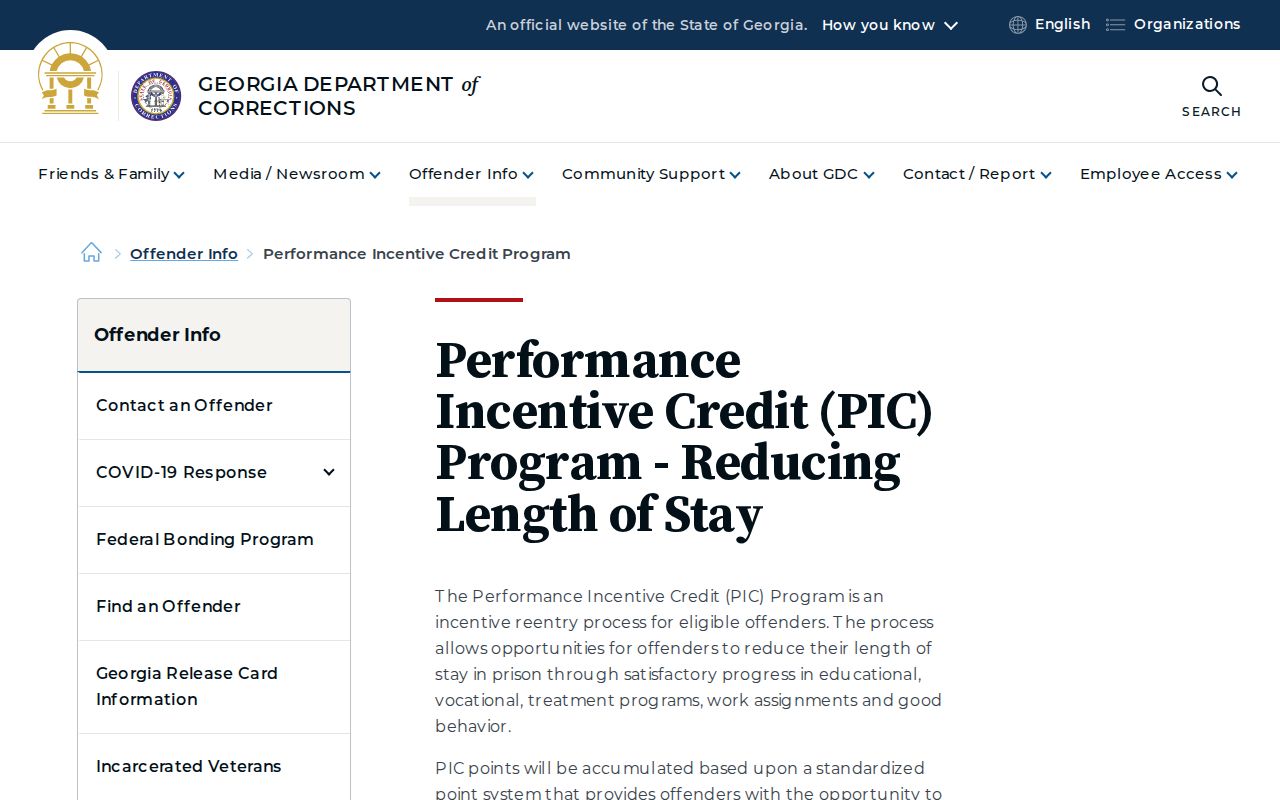
The program details show why an earned reduction must be confirmed in GDC records instead of estimated from a court sentence alone.
Why Murray County Release Dates Change
A release date is a result of live records, not simple subtraction from the sentence. The controlling factor depends on whether the person is held locally, serving a state sentence, or awaiting a parole decision. Some changes move a date earlier. Others postpone release or change the destination from the community to another custody agency.
| Factor | Possible effect | Best source |
|---|---|---|
| Bond or court order | Can authorize or delay a county jail release | Murray County Jail and issuing court |
| Sentence credit or correction | May revise the computed end date | Court order, GDC record, or jail record |
| PIC eligibility and points | May reduce a qualified state TPM or maximum date | GDC |
| Misconduct or unmet program terms | May postpone or cancel a TPM | Parole Board and GDC |
| Parole grant, denial, or reconsideration | Changes whether and when parole release may occur | State Board of Pardons and Paroles |
| Detainer or transfer | May prevent community release despite leaving one facility | Holding and receiving agencies |
| Data correction | Can alter an online date without changing the sentence itself | Agency that maintains the record |
When a GDC calculation seems wrong, the family FAQ directs the incarcerated person to a counselor and then the grievance process. It also notes that county jail credit issues may require the clerk in the county of conviction. For a Murray County case, that means the Murray County Clerk of Superior Court.
Confirm a Murray County Release Date
Confirm with the agency that holds the person. Murray County Jail is first for a local detainee. GDC and Inmate Records and Information are first for a state prisoner. The court is first when the date turns on a bond order, sentence, credit, revocation, or modification. Ask whether the date is projected, maximum, scheduled, or actual.
Georgia VINE can add a custody-change alert where a participating feed covers the person. It does not explain the sentence computation or prove the legal reason for release. The Murray County VINE Inmate Check explains the person search and alert registration process.
A released result should be checked for transfer language. If a person is gone from the county jail but appears at a GDC facility, the event was a transfer into state custody. If another hold exists, the person may leave one agency without entering the community.
Note: Notification is useful for timing, but the jail, GDC, or court record remains the source for the exact release basis.
Murray County TPM Is Not Release
A Tentative Parole Month is the month when the Board plans to complete final review and may set a parole release date. It is not the date the prison gate opens. The Board may require good conduct, program completion, or another precondition, and misconduct usually causes postponement or cancellation.
The TPM application accepts a six-digit inmate number, GDC ID, or personal data. It serves a Murray County defendant who entered state prison, not someone whose only event was bonding out of Murray County Jail. The Board can also deny parole or reconsider an earlier decision before release.
The Parole Board's TPM explanation states the limits of this planning month.
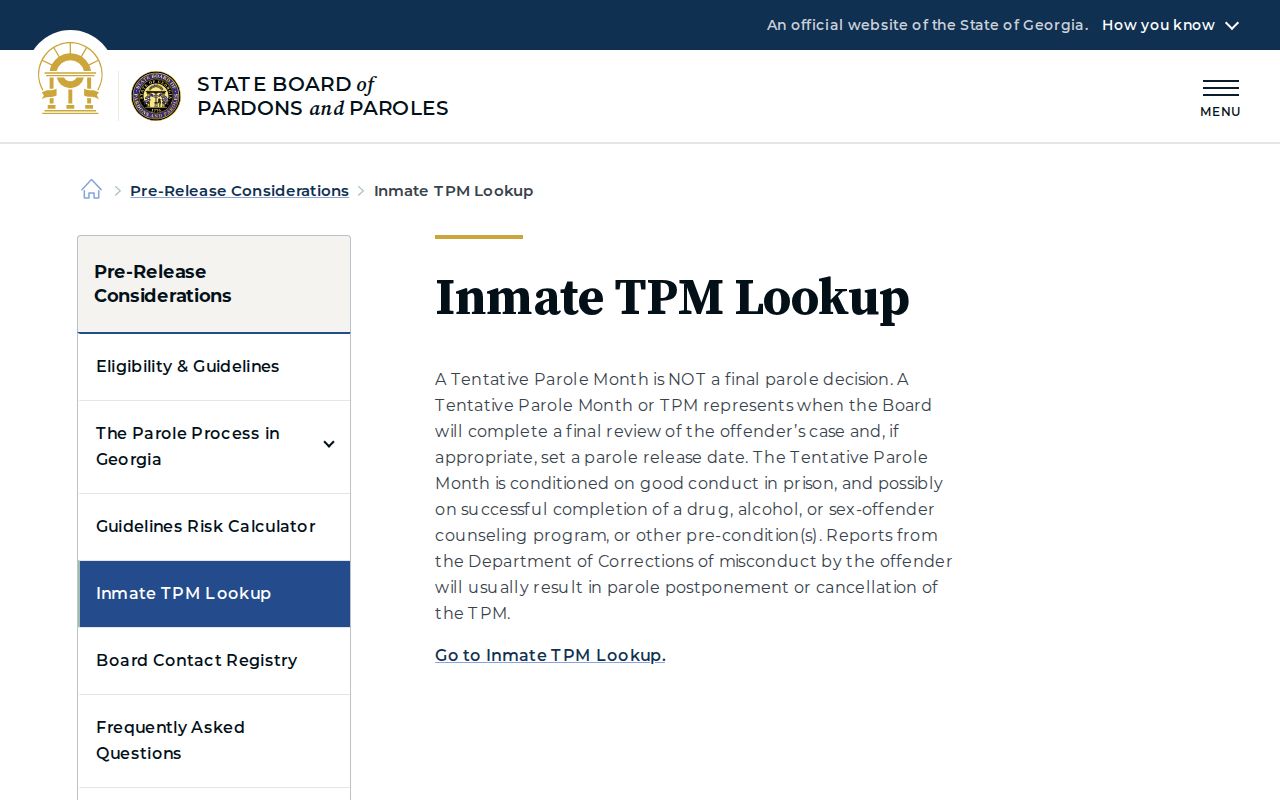
The distinction between final review and a set release date is essential when families plan around a state-prison record.
Murray County Serious-Felony Date Limits
Georgia does not apply one universal “85 percent” formula to every Murray County inmate. O.C.G.A. § 17-10-6.1 lists serious violent felonies and imposes mandatory minimum and release limits for covered sentences. Certain minimum terms cannot be reduced by earned time, early release, work release, leave, or other DOC sentence-reduction measures.
The statute includes murder or felony murder, armed robbery, kidnapping, rape, aggravated child molestation, aggravated sodomy, and aggravated sexual battery. Life-sentence rules can also impose long parole-ineligibility periods based on the offense and conviction history. The sentence and offense date matter, so a rough percentage cannot replace the judgment and state computation.
The Georgia serious violent offender statute is the official legal anchor for these limits.
Its sentence-specific restrictions explain why PIC or an early parole estimate may not apply to a covered state sentence.
Murray County PIC and TPM Interaction
A state record may show a maximum release date, a TPM, and a court sentence. Those are not three labels for the same fact. The court imposes the sentence. GDC computes state custody and may apply eligible PIC points. The Parole Board controls parole review and any eventual parole release decision.
PIC may reduce either an eligible TPM or Maximum Release Date, but the new TPM is still tentative. A reduction does not prove that final review is complete. Conversely, a maximum date is not a promise that no lawful event can alter the record before then.
For a Murray County Jail sentence, none of this establishes local good time. Ask the jail and the sentencing court for the rule and order that apply to that booking. This custody split is the safest way to avoid giving a state-prison answer to a county-jail question.
A useful date check creates a short record trail. Save the GDC identifier, note whether the field says maximum release or another date type, and record when the search was viewed. Then compare it with the TPM lookup and the court sentence only when each source applies to the same state case. If the dates conflict, ask the agency that computes the disputed field instead of choosing the earliest one.
County cases need a different trail. Keep the booking number, court case number, name of the issuing court, and the exact order that affects release. Ask the jail whether any outside hold remains after the local order is satisfied. A bond order can authorize release from the local case while another detainer keeps the person in custody or sends them to another agency.